
Holidays
One stop solutions for planning holidays!
Creating a brand new holiday booking experience for an airlines
Users
Any, a B2C application
mostly targeting users in
Middle-East
& South Asia
My Role
Requirement Analysis,
User Research,
Competitive Research,
Interaction Design
Team
1 Design Manager
2 Design Leads
3 Interaction Designers
&
2 Visual Designers
Duration
Months
(Sept 2016 - March 2017)
Background
Flydubai was seeking to expand our services by venturing into the holiday booking solution. This will involve providing a platform for customers to not only book flights but also plan and book their entire holiday, including accommodations, activities, and other travel essentials.
Objectives
1.
To provide a one-stop platform for customers to plan and book their holidays, including flights, accommodations, and activities.
2.
To provide a one-stop platform for customers to plan and book their holidays, including flights, accommodations, and activities.
3.
To enhance customer engagement and satisfaction by offering a comprehensive holiday booking solution.
Target Audience
Our target audience includes individuals, families, and businesses looking to plan and book their holidays. We aim to cater to both leisure and business travelers.
Key Features
-
Integrated Booking System: A user-friendly platform that allows customers to book flights, accommodations, and activities in one place.
-
Customization Options: The ability for customers to personalize their holiday itineraries based on their preferences.
-
Collaboration Tools: Features that enable group travel planning and coordination.
-
Payment Integration: Seamless and secure payment processing for all bookings.
Research
Where are we today?
The first step was to understand the current state of flight booking in Middle Eastern countries and the reasons behind FlyDubai's interest in transitioning to a comprehensive holiday booking platform. To achieve this, we held multiple remote meetings with the FlyDubai team, which included a project manager, members of FlyDubai's management, the marketing team, customer service representatives, and the technical team.
These collaborations were important for:
Initial Research and Discovery
Get a thorough understanding of FlyDubai's objectives, target audience, and market positioning. This included reviewing existing documentation, conducting stakeholder interviews, and gathering any initial user research data available.
Defining the Problem
To identify key problems and challenges that the platform needed to address. This step involved articulating clear problem statements that would guide the design process.

Secondary Research for Competitors
Conducting secondary research on competitors was crucial for understanding the market landscape and identifying opportunities for differentiation.
Here are the detailed steps:
Identifying Competitors
We started by identifying major competitors in the travel booking industry, focusing on those operating in the Middle East and globally. This included both direct competitors (other airlines with booking platforms) and indirect competitors (general travel booking websites).
Analyzing Features and Functionality
We conducted a detailed analysis of the features and functionality offered by competitors. This involved creating a feature matrix to compare key aspects such as booking processes, customization options, user interfaces, and additional services.

Define
User Personas
The creation of user personas was a crucial step in ensuring that the Holidays website/application met the diverse needs and preferences of its target audience. By developing detailed personas, we could tailor the platform's features and design to resonate with the users' goals, behaviors, and pain points.


By creating these personas, we were able to align the platform's design and functionality with the distinct needs and expectations of our users. This persona-driven approach not only enhanced user satisfaction but also enabled FlyDubai to effectively cater to a broader audience, ultimately contributing to the success of the Holidays website/application.
Brainstorming and Ideation Workshop
To foster idea generation and collaboration, we organized a two-day workshop involving stakeholders from both FlyDubai and the Imaginea team.
The workshop aimed to set the context, create detailed user flows, and identify key opportunity areas. Over the course of these two days, we engaged in brainstorming sessions, interactive discussions, and collaborative activities to generate innovative ideas and solutions.
At the end of the workshop, we reviewed and discussed our findings and proposed user flows with the FlyDubai team.
This collaborative effort allowed us to align on a shared vision and finalize the approach for the next steps in the design process, ensuring that all stakeholders were on the same page and committed to the project's success.


Defining User Journey
To ground our ideas in reality, we mapped out user journeys simultaneously with the ideation process. This ensured our personas' paths were aligned with both stakeholder business goals and the creative concepts generated during brainstorming.

Design

Focus on users
As FlyDubai transitions into a one-stop holiday booking platform, understanding and prioritizing the needs of diverse users—such as families, adventurers, and travel agents—ensures that each user group finds the platform valuable and easy to use. This focus helps in creating a tailored experience that enhances user satisfaction and retention.
Clarity of information
For a comprehensive booking platform, presenting clear information about flights, accommodations, packages, and services is essential. Users need to quickly grasp the options available, the benefits of each choice, and any associated costs or conditions. This clarity helps users make informed decisions, reducing the likelihood of frustration or abandonment.
Clarity of process
Ensuring a clear booking process is vital for FlyDubai’s holiday platform. Users should easily navigate through planning, selecting, and booking their holidays without encountering confusion or unnecessary steps. Clear process flows enhance user confidence and streamline the booking experience, leading to higher conversion rates.
Easy comparison
Offering easy comparison features for flights, hotels, excursions, and other services allows users to weigh their options effectively. This is particularly important in a one-stop holiday booking platform where users might consider multiple factors before making a decision. Simplifying comparisons helps users quickly find the best options that meet their needs, improving satisfaction and conversion.
Helpful and relevant
As FlyDubai expands its services, offering helpful and relevant information becomes crucial. Whether through contextual tips, FAQs, customer support, or personalized recommendations, ensuring that users receive timely and relevant assistance can significantly improve their booking experience. This principle helps build trust and reliability, encouraging users to return for future bookings.
Application Designs

Wireframes


Visual Designs
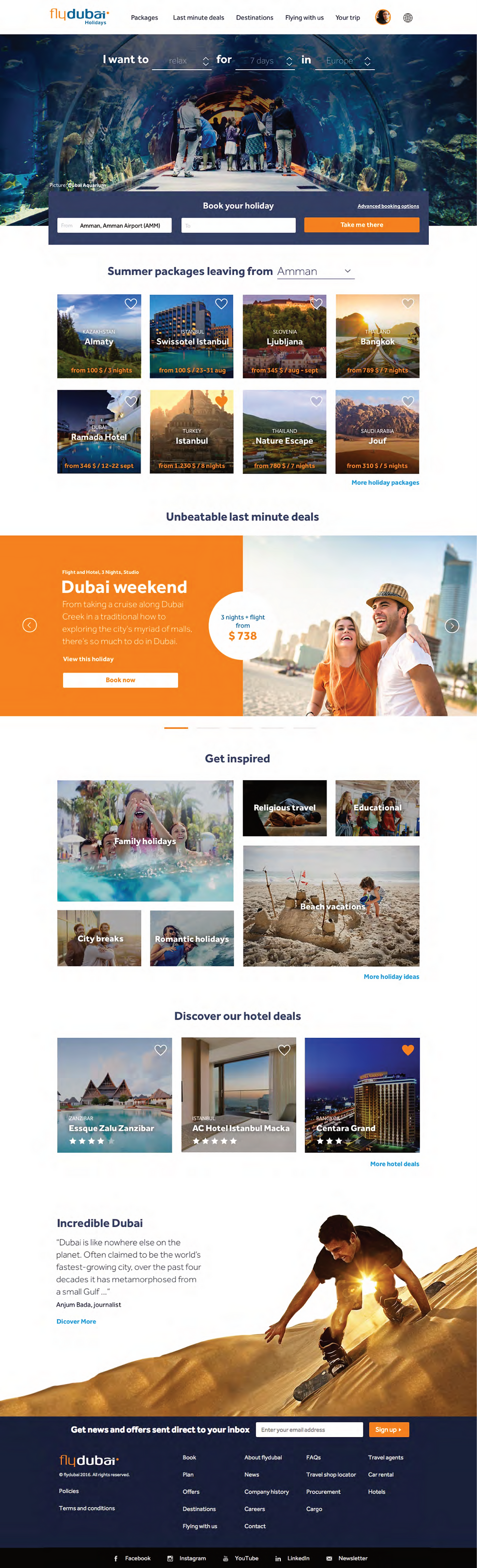


Responsive & Internationalization


Usability Testing
The usability testing (UT) for Holidays by flydubai was a rigorous research initiative conducted at the flydubai premises to evaluate the platform’s performance through the lens of potential users. The findings were formally presented to flydubai stakeholders and we utilized these evidence-based insights as a primary roadmap to further refine the application's interface and user flows.
Pre-Testing: Preparation & Setup
The research team—comprised of Me and other 3 senior members of the Design team. Before engaging with participants, me and another member of the Research Team—developed a comprehensive suite of artifacts and conducted pilot testing to ensure study validity.
-
User Screening: A formal Screener was used to recruit 40 frequent or potential travelers.
-
Moderator Scripting: Detailed scripts were created to ensure consistent briefing and scenario delivery across all sessions.
-
Pilot Testing: A dedicated "Day 1" was allocated for setup and a pilot test to update and refine task scenarios before full-scale execution.
-
Pre-Test Questionnaire: Administered to capture user profiles, tech affinity, and existing travel habits.
Research Execution & Participant Overview
The core testing was executed over four days, with the research team divided into two UT teams (each with one moderator and one observer/logger) to maximize efficiency.
-
Participant Scale: A total of 40 users were recruited for the study.
-
Attendance: There were 4 "No Shows," resulting in a robust sample size of 36 active participants for the in-person sessions.

Quantitative Results Summary
The testing successfully uncovered 35 distinct problem areas across the booking journey.
These were categorized by severity to help the design team prioritize high-impact fixes.

Strategic Design Refinement
The presentation to stakeholders highlighted that 66% of identified issues were either Major or Critical, necessitating immediate design iterations.
-
Mental Model Correction: The design team focused on clarifying the "Holiday" package concept (flights + hotel) vs. standalone services.
-
Simplifying Complex Flows: Based on the high error rates, the team prioritized re-engineering the Room Selection process, which was identified as the most complex part of the user journey.
-
Pricing Transparency: The interface was refined to ensure users no longer misinterpreted the total package price as an "exclusively hotel price".
Conclusion
Designing the flydubai Holidays experience was a defining moment in my career, marking two significant firsts: my entry into large-scale B2C product design and my introduction to rigorous Usability Testing.
Transitioning to a consumer-facing product for a major airline raised the stakes immediately. Unlike my previous B2B work—where users are often subject matter experts or receive training—I realized that B2C demands a significantly higher standard of intuitive design. While our personas provided strategic focus, a global holiday booking application must accommodate a vast spectrum of digital literacy and cultural contexts. The interface had to be resilient enough to serve millions, not just the 'ideal' user defined in our research.
This pressure made the usability testing process even more critical. Sitting across from actual users and watching them interact with my designs was a profound reality check. It taught me that in the B2C space, user patience is thin, and clarity is king. This experience fundamentally shifted my approach from designing for screens to designing for human behavior.